
Caddo County Release Date Types
Four dates must stay separate. A projected release date is a current estimate based on sentence rules and the record as it stands. Parole eligibility is the first point when a case may be considered under the law that applies; it is not a grant. A discharge date marks the recorded end of the identified ODOC sentence or supervision. The actual release date and time document the completed physical event. One date cannot safely stand in for the others.
A pretrial detainee at the Caddo County Jail may have no sentence-based release date at all. Bond, dismissal, court action, a new hold, or later sentencing can control what happens. A person serving a local jail sentence should ask the jail and court about the commitment, recorded jail credit, and completion. State-prison credit tables should not be applied to a county sentence without proof that those rules govern it.
- Projected date
- A tentative estimate based on current sentence and credit data.
- Eligibility date
- A point when parole review may become legally available.
- Actual release
- The completed physical departure recorded by the custodian.
- Discharge
- The end of the identified correctional sentence or supervision.
Find Caddo County Projected Dates
Begin by classifying the custody. The sheriff, court, and ODOC maintain different records. A bonded-out local detainee does not belong in a state sentence calculation. A person committed from Caddo County to Great Plains or another state prison does. The best search uses a stable identifier and then matches the county and case rather than relying on a name alone.
- Decide whether the person is pretrial, serving a local jail term, or serving an ODOC sentence.
- For local custody, review the Caddo County OSCN case and ask the jail or Court Clerk about the controlling order and jail credit.
- For state custody, use the ODOC offender search with the DOC number when available, or name and date of birth.
- When parole review is scheduled, check the monthly PPB docket for its Projected Release Date and related sentence fields.
- Read the corresponding PPB result after the meeting; a scheduled appearance is not a decision.
- Confirm the completed event through ODOC status or a Certificate of Release, Discharge Notice, Release Checkout Sheet, or Termination Summary.
The ODOC search form offers an OK DOC number, first name, last name, date of birth, alias-data option, similar-sounding-name option, and CAPTCHA. Compare a possible match with the photo, date of birth, DOC number, conviction county, and case. The current person-result screen was not verified through CAPTCHA, so no exact public future-date field or released label should be promised.
The official search inputs are shown in the ODOC offender-search source pictured below. They are designed for state custody or supervision, not a person who only left the Caddo County Jail on bond.
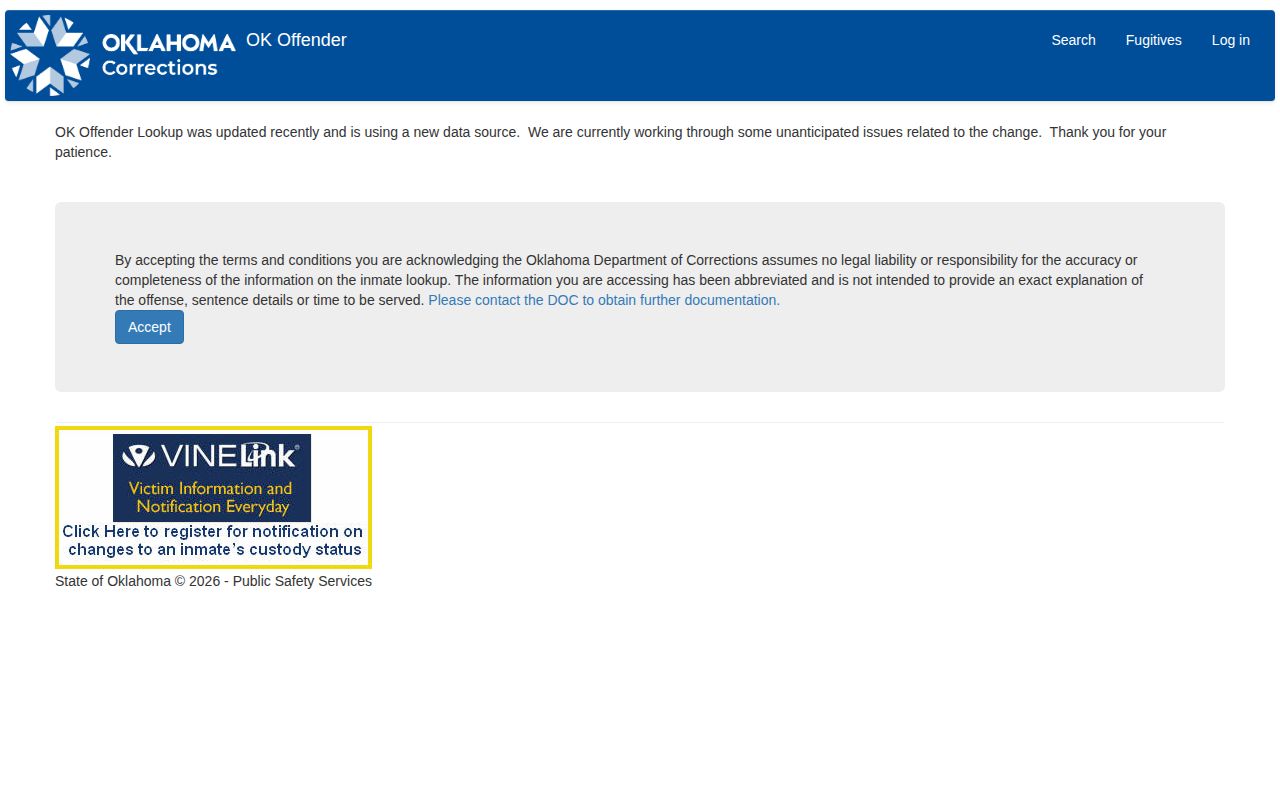
The image highlights identity matching at the start of the process. The sentence and release documents come later from the responsible ODOC record.
Caddo County Parole Docket Dates
Oklahoma presents a notable tension. Public Pardon and Parole Board dockets use the exact field “Projected Release Date.” That date appears beside context such as ODOC number, proceeding type, offense and county, parole authority, jail time, reception date, sentence, concurrent or consecutive cases, and detainer. The neighboring fields show why the estimate cannot be read in isolation.
At the same time, the ODOC offender-information FAQ says precise future release information is confidential without an appropriate judicial, law-enforcement, or similar need. It also describes future dates as tentative because credits, class level, misconduct, and achievements may change the calculation. The safe reading is narrow: a PPB docket estimate gives public parole-review context, while ODOC may not disclose an exact future exit date through every public channel.
The official ODOC warning is visible below. It is the right check against treating a docket estimate like an appointment time at the prison gate.
The source explains why the current estimate can move and why final proof must come from a completed correctional record.
Note: A PPB docket schedules consideration and supplies context; it does not establish that a person physically left custody on the projected date.
Oklahoma Credits for Caddo Sentences
For an ODOC term, 57 O.S. §138 provides the earned-credit framework unless another law controls. One credit equals one day of incarceration. Monthly credits depend on class level and whether the person has ever had an enumerated felony under subsection E. Because the compilation includes versioned provisions, the law that applies to the offense and sentence must be checked.
| Class | Enumerated felony history | No enumerated felony history |
|---|---|---|
| Class 1 | 0 credits per month | 0 credits per month |
| Class 2 | 22 credits per month | 22 credits per month |
| Class 3 | 33 credits per month | 45 credits per month |
| Class 4 | 44 credits per month | 60 credits per month |
Section 138 also authorizes achievement credits subject to eligibility and completion rules. The current compilation lists 200 credits for a bachelor's degree, 100 for an associate's degree, 90 for a high-school diploma or equivalency, 80 for a vocational-training certificate, 70 for qualifying substance-treatment completion, and 10 to 30 for other approved achievements. Those figures explain the framework. They do not promise any credit to a particular person.
Credits may be lost for misconduct, discipline, or nonperformance through the required process. They may later be restored under ODOC policy. No credit reduces a life sentence, although participation data may still matter in parole review. Monthly classification, program completion, discipline, restoration, and audit corrections can all move the projection.
Caddo Jail Credit to ODOC
The county-to-state transition can change the starting data. Section 138(G) addresses jail time tied to a state sentence before ODOC reception. Qualifying pre-transfer jail time is deducted from the state term. A person sentenced to ODOC but still held at the county jail while awaiting reception can receive specified credits from judgment and sentence, subject to statutory exceptions.
That makes four records important: the judgment date, jail-time statement, ODOC reception date, and later calculation audit. The court states the credit or commitment in its legal record. ODOC administers the state term. Their roles are related but not identical. If the projection appears wrong, the person may seek help through the facility records officer or case manager. An authorized requester may ask for the Consolidated Record Card, jail-time statement, or calculation record.
No homemade calculator can reliably recreate this work. It would miss offense-date versions, record-specific exceptions, corrected jail time, concurrent or consecutive terms, and changes made after discipline or a new court order. The actual record controls.
Caddo County 85 Percent Cases
For serious offenses listed under 21 O.S. §§12.1 and 13.1, at least 85 percent of the imposed prison sentence must be served before parole eligibility. Earned and other credits cannot reduce confinement below that statutory floor. The listed offenses and versions have changed, so the conviction offense and offense date control. A charge should never be labeled an 85 percent case merely because its name sounds violent.
The PPB material explains that nonviolent cases commonly reach eligibility after 25 percent or one-third, depending on date and law, while many violent or specially designated cases require 85 percent. Death and life-without-parole sentences are not eligible. The wider framework includes 57 O.S. §332.7 and relevant §571 designations.
Eligibility still does not equal release. A favorable vote in a qualifying violent case is a recommendation to the Governor. A qualifying nonviolent grant falls within the Board's authority. Either outcome may precede validation, residence arrangements, prerequisites, paperwork, or another detainer.
What Moves Caddo Release Dates
A projected date is the output of a living sentence record. Some changes shorten the current estimate; others extend it or prevent a planned exit. The cause should be tied to an agency entry rather than guessed from the difference between two screenshots.
| Factor | Possible effect |
|---|---|
| Monthly class level | Changes the rate at which ordinary earned credits accrue. |
| Achievement credits | May reduce time after eligible, verified completion. |
| Misconduct or nonperformance | Can cause credits to be lost through the required process. |
| Restored credits | Can revise a projection after an approved restoration. |
| Jail-time correction | Changes credit for custody before ODOC reception. |
| Concurrent or consecutive terms | Changes how multiple sentences run together or one after another. |
| Court or parole action | Can alter authority, eligibility, or the path to release. |
| Detainer or other hold | May send the person to another authority instead of the community. |
A detainer is a request or legal basis for another authority to take custody. It can remain even when the ODOC term reaches its projected point. The resulting movement is a transfer, not proof of unrestricted community release.
Prove Caddo County Actual Release
For a local detainee, the sheriff's release record is the best source for the physical jail event. OSCN may show bond, dismissal, time served, a suspended sentence, or commitment, but a court entry does not always record the exit minute. Ask the Caddo County Sheriff's Records Division for the date and time, recorded type or authority, and transfer destination if maintained and public.
For an ODOC prisoner, use status or movement information and a named document. OP-060212 identifies the Certificate of Release, Discharge Notice, Release Checkout Sheet, Final Disposition Report, Termination Summary, Parole Status Report, Notice of Inmate Status Change, jail-time statements, detainers, and credit records. ODOC Legal Services handles requests subject to confidentiality, authorization, redaction, or court-order limits.
A custody alert can help mark when to check again. The Caddo County VINELink release check explains the one-person search and its transfer caveat. VINE does not provide parole notification, so the PPB result and ODOC record must still be reviewed when parole applies.
Use the language from the final record. “Released on bond,” “transferred to ODOC,” “paroled,” and “discharged” describe distinct outcomes. A Caddo County projected release date becomes historical proof only when the responsible agency records what actually occurred.